About the project
“The Founding Fathers of International Relations Theory Loved War but Overlooked Sex.” This was the headline of an article published in February 2021 in the US political magazine Foreign Policy. The author stated that modern political science has consistently ignored one of the most important historical dynamics of “international” politics: dynastic marriage policy.
This finding is surprising insofar as dynastic marriages, their origins, and their effects have long been recognized as an important topic in historical scholarship. This is particularly true with regard to the early modern period in Europe between approximately 1500 and 1800, which saw the rise of large empires such as that of the Habsburgs, founded in part on marriage policy.
Dynastic marriage policy in the early modern period is significant for historical research in that the dynastic princely state became the dominant form of political community in early modern Europe from around 1500 onwards and remained so until the end of the era around 1800. Monarchs had a decisive influence on the fate of Europe with their policies, which were oriented toward the interests of their dynastic family associations. The marriage policies of the major royal houses were therefore a central component of political relations between the communities and states of Europe. As a result, they became fundamentally relevant to security and peace during the early modern period.
However, historians have come to very different conclusions about the specific impact of dynastic marriage policy. On the one hand, it is assumed that dynastic marriage policy could be an obstacle to stability and peace and a major cause of conflicts and wars, as it was aimed, among other things, at raising the rank and acquiring territory. On the other hand, there is the assumption that Europe’s royal houses attempted to achieve ‘more’ security and peace through their marriage policies and marriage contracts.
However, new research findings indicate that the political actors involved in princely marriage policy in the early modern period were primarily concerned with creating opportunities for dynastic action rather than realizing large-scale peace plans. Overall, dynastic marriage policy in a political and confessional environment that, as historian Johannes Burkhardt notes, was characterized by a structural deficit of peace, could appear as an indicator of structural security problems, but also point to solutions to those problems.
The significance and scope of dynastic marriage policy in the early modern period can be seen, among other things, in the lengthy negotiations over marriage contracts that usually preceded the marriages. Such marriage contracts provide insight into various security issues that were important in the context of dynastic marriage policy and shed light on the dynastic security and honor concepts of actors in the early modern period.
As sources, they are relevant to a wide range of historical questions: dynastic marriage contracts not only provide insights into the relationship between the princely houses involved and the practice of dynastic marriages, but also contain extensive provisions relating to persons, property, assets, and inheritance law. The complete indexing of the marriage contracts of royal houses in a database thus enables comprehensive and comparative access to a broad source base on various questions of European history in the early modern period.
Our database of early modern marriage contracts from 1500 to 1800 is part of subproject A03 Dynastische Eheverträge und Versicherheitlichung within the Sonderforschungsbereich/Transregio 138 Dynamiken der Sicherheit. The SFB/TRR 138 comprises various subprojects at Philipps-Universität Marburg, Justus-Liebig-Universität Gießen, and the Herder-Institut für historische Ostmitteleuropaforschung in Marburg.
The aim of the SFB is to research the historical development of security concepts and their successive integration into political processes, as well as their significance and impact in this context. The focus is on the representation and creation of security. Both processes are historically directly related to each other and are being researched within the framework of the SFB in terms of their relationship to each other and in historically different dynamics and process structures.
In this context, subproject A03 aims to systematically record and index the security aspects of dynastic marriage contracts that were relevant to early modern actors. However, dynastic marriage contracts are also central sources for researching European political, cultural, legal, and gender history of the early modern period, beyond the research focus of the SFB/TRR 138. The database therefore offers a broad range of data that researchers from all historical disciplines can draw on for their projects.
In contrast to many other historical databases, we do not make digitized versions of the original sources or a complete digital edition of the contract texts available. Instead, our database offers regesta of the evaluated marriage contracts, which are linked to further information (e.g., through links to the GND) and information on which archive or edition the complete contract text can be found in. If digitized versions of the sources are available on the web, we also link to them. In addition, we offer our data records for download as PDF files.
The database project focuses on the research-oriented processing and provision of content from dynastic marriage contracts dating from approximately 1500 to 1800. The database primarily includes and evaluates marriage contracts between royal houses, at least one of which either had royal status at the time of the marriage or attained it during the early modern period.
In a first step, around 400 princely marriages that meet these criteria were identified. The main source used for this was the genealogical reference work Stammtafeln zur Geschichte der europäischen Staaten, founded in 1935/36 by Wilhelm Karl von Isenburg, which was continued from 1968 as Europäische Stammtafeln.
In a second step, an analysis grid was developed for the evaluation and registration of the contracts. Information about the dynasties and communities involved, as well as the specific political actors involved, is included, as is the content of the contracts. In addition, provisions relating to succession and inheritance law, as well as confessional provisions, the involvement of estates or foreign authorities, accompanying contractual regulations, and the historical context are documented.
As a rule, the regesta of the marriage contracts are based on archival and/or printed versions of the contract texts. Where possible, links to digitized versions available on the web are provided. Links to the Gemeinsame Normdatei (GND) are also included, if GND data records are available for the persons and actors relevant to the contract.
Project management: Christoph Kampmann
Team members: Richard Herzog, Tobias Kindel, Julian Katz, Christian Wenzel, Anja Krause, Bengt Büttner, Philip Haas, Bjarne Trampnau
The filter search within the tabular database listing allows you to filter by specific terms. These filters are limited to unique search terms that can be found in the table fields. This allows you to search for properties such as locations, contracting parties, or years, but the filter search does not capture terms or phrases outside the specified filter categories. If you are searching for a combination of properties, you can enter them in the search field, separated by spaces. In this case, only those entries that contain all the terms entered will be displayed.
The filter search is supplemented by the full-text search, which can be accessed via the magnifying glass icon in the navigation bar. The full-text search offers a more comprehensive view of all content on the website. For example, terms and content from contract texts, names, or even GND-IDs of parties involved can be found in the data and texts of the respective entries.
Depending on your needs, either the filter search or the full-text search may be the appropriate method for finding the desired data.
Our contract registers contain numerous source terms that appear in the dynastic marriage contracts evaluated for the project and are also used in the research literature. However, since we assume that terms such as trousseau or morning gift cannot necessarily be considered self-explanatory, we have created an interactive glossary that explains the most important terms in detail.
We welcome feedback from our users! If you have any questions, suggestions, or additions regarding the project, database, or website; if you would like to share information about a specific contract or register; if you have discovered an error in our data; or if you have information about contracts, editions, or archival materials that are relevant to our project but that we may not yet be aware of, please feel free to contact us at any time. Please use our feedback and contact form. You can find it under the Tools tab.
In the contract registers, which you can find in our database, as well as in the scientific glossary, the sources used and literature titles are only given in abbreviated form. The archives in whose holdings we were able to find original contracts are also only listed with abbreviated information (e.g., HStAM for the Hessian State Archives in Marburg). To help you decipher the abbreviated titles and abbreviations, we offer all complete source and literature references in PDF format for download under the menu item Literature and Sources. The lists are updated regularly for your convenience.
Credits for images used on the website:
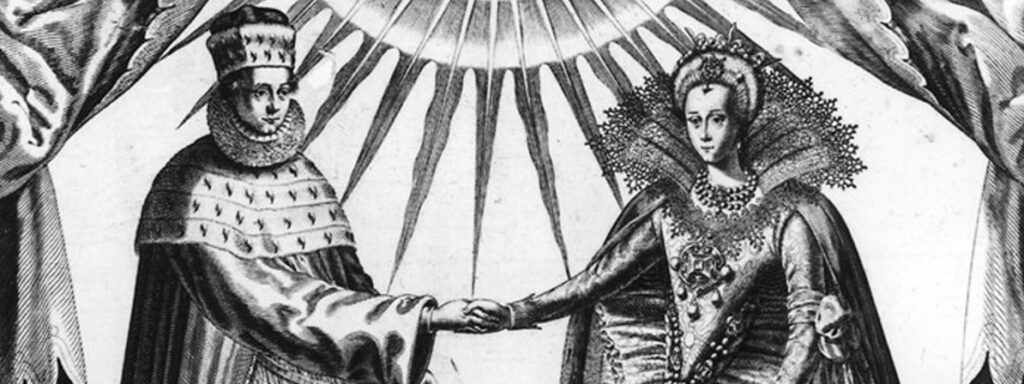
Stage design “Home page”: Dedication page: Marriage of Elector Frederick V of the Palatinate to Princess Elizabeth of England, anonymous copperplate engraving from 1613. Used with the kind permission of the Germanisches Nationalmuseums Nürnberg.
Stage design “Project”: Dedication page: Marriage of Elector Frederick V of the Palatinate to Princess Elizabeth of England, anonymous copperplate engraving from 1613. Used with kind permission of the Germanisches Nationalmuseums Nürnberg.
Stage design “Sources & Literature”: DuMont, Jean: Corps Universel du Droit des Gens; contenant vn Recueil des Traitez d’Alliance, de Paix, de Treve, de Neutralité, de Commerce, d’Echange, de Protection & de Garantie, de toutes les Conventions, Transactions, Pactes, Concordats, & autres Contrats, qui ont été faits en Europe, depuis le Regne de l’Empereur Charlemagne jusques à present […]. Bd. V, 2. Amsterdam 1728, S. 476. Digital copy made available online by the Bayerische Staatsbibliothek without copyright protection.
C2A teaser “About the project” on the home page: color-modified excerpt from: Dedication page: Marriage of Elector Frederick V of the Palatinate to Princess Elizabeth of England, anonymous copperplate engraving from 1613. Used with the kind permission of the Germanisches Nationalmuseums Nürnberg.
C2A teaser “Marriage contracts” on the home page: color-modified digital copy from: HStAM, Urk. 3, No. 119: Marriage contract between Landgrave Ludwig IV of Hesse-Marburg and Duchess Hedwig of Württemberg. Used with kind permission of the Hessisches Staatsarchiv Marburg.
C2A teaser “Feedback” on the home page: color-modified excerpt from: Portrait of Erasmus of Rotterdam, copperplate engraving by Albrecht Dürer, 1526. Used with kind permission of the Graphik-Kabinett der Stadt Backnang.
C2A teaser “Glossary” on the home page: color-modified excerpt from: Portrait of Erasmus of Rotterdam, copperplate engraving by Albrecht Dürer, 1526. Used with the kind permission of the Graphik-Kabinett der Stadt Backnang.
C2A teaser “Sources & Literature” on the home page: color-modified excerpt from: Portrait of Erasmus of Rotterdam, copperplate engraving by Albrecht Dürer, 1526. Used with the kind permission of the Graphik-Kabinett der Stadt Backnang.
C2A teaser “Search tips” on the home page: color-modified excerpt from a woodcut in: Brant, Sebastian: Nauis stultifera a domino sebastiano Brant. Basel 1507. fol. a ij verso. Digital copy made available online by the Bayerische Staatsbibliothek under a Creative Commons license.